What Is Whole-Body EMS, and Why Are U.S. Professionals Paying Attention?
A practical introduction to Whole-Body EMS for U.S. trainers, clinics, studios, and wellness professionals—what the system is, how it works, what research supports, and where it may fit professionally.
09/05/2026
8 min read

What Is Whole-Body EMS and Why Are U.S. Professionals Paying Attention?
If you have seen someone exercising in a fitted suit connected to a control unit, it is easy to assume the suit itself is the technology.
It isn’t.
The suit is one part of a Whole-Body Electrical Muscle Stimulation system, usually shortened to Whole-Body EMS or WB-EMS. The system combines electrical stimulation with voluntary movement, individualized settings, and, when delivered professionally, screening, programming, and supervision.
For U.S. trainers, clinics, studios, and wellness professionals who are starting to hear more about WB-EMS, the more useful question is not whether the suit looks impressive.
It is:
What is the technology actually doing, and could it add something useful to the way we already train people?
That is what this article is about.
What exactly is Whole-Body EMS?
Whole-Body EMS is a training method that uses electrical impulses to stimulate several major muscle groups at the same time.
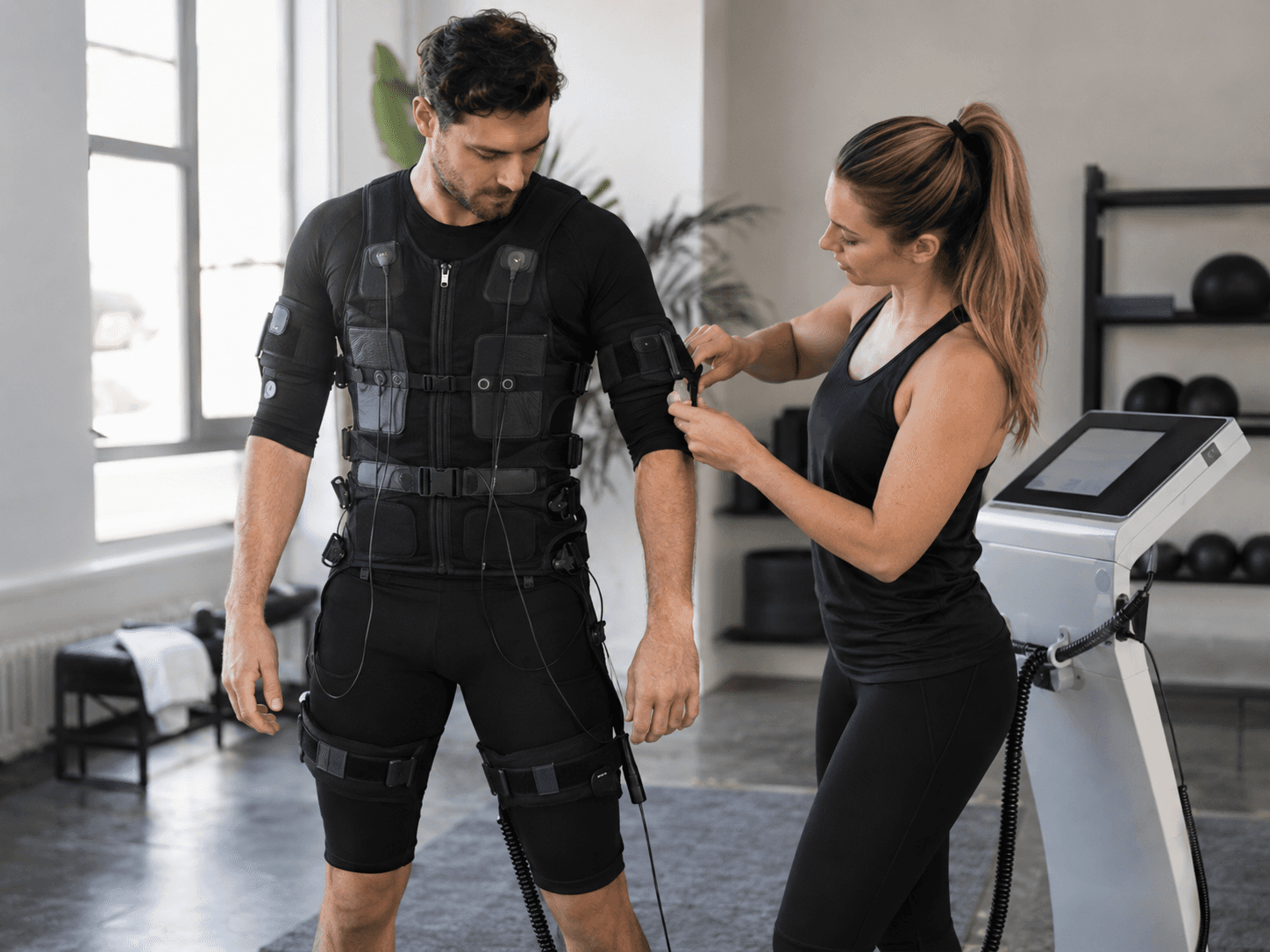
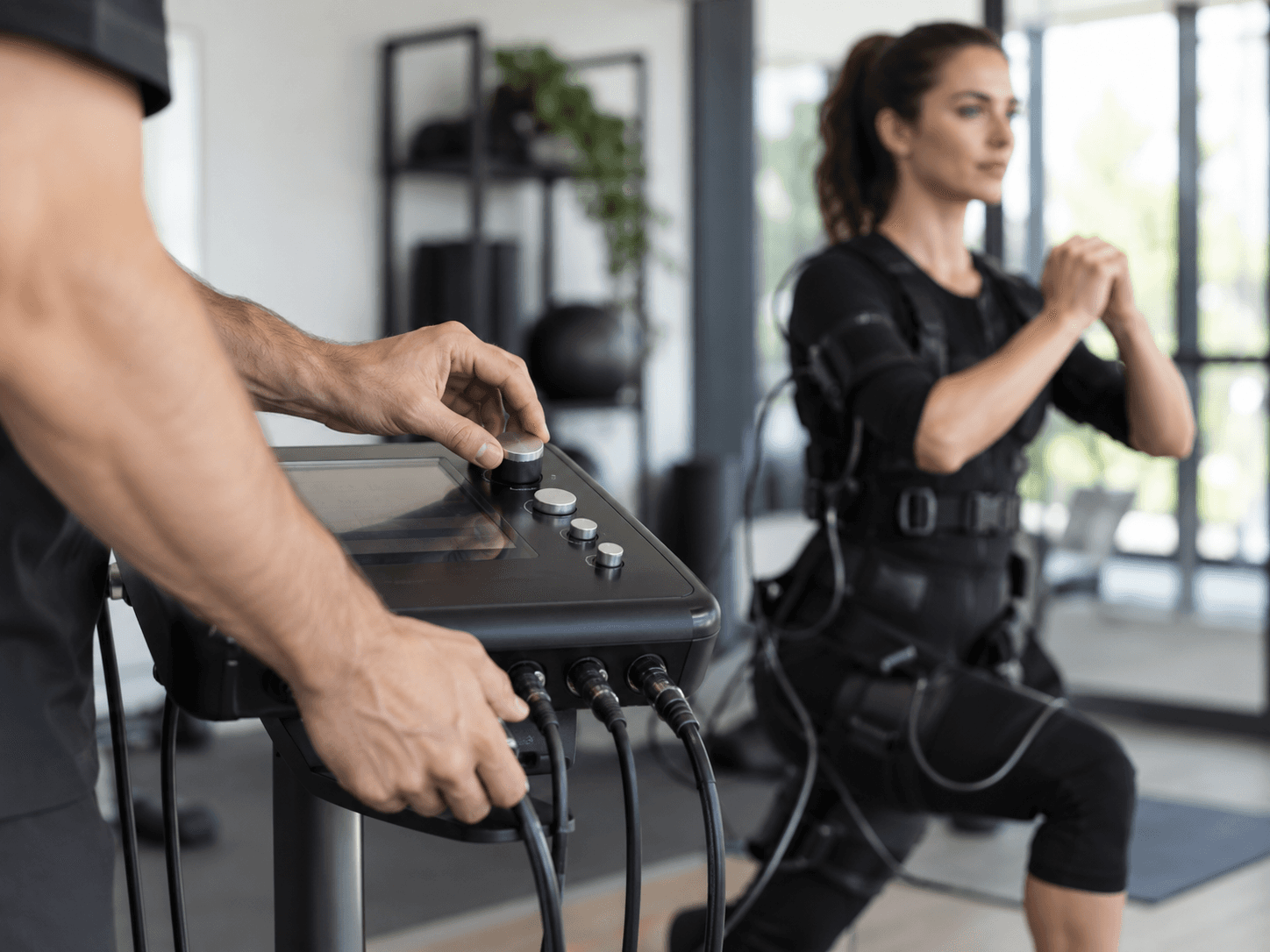
A participant typically wears an electrode garment or suit that places electrodes over areas such as the legs, glutes, abdomen, back, chest, and arms. Those electrodes are connected to a control system that allows stimulation to be adjusted for different parts of the body.
The participant does not simply stand there while the machine does everything.
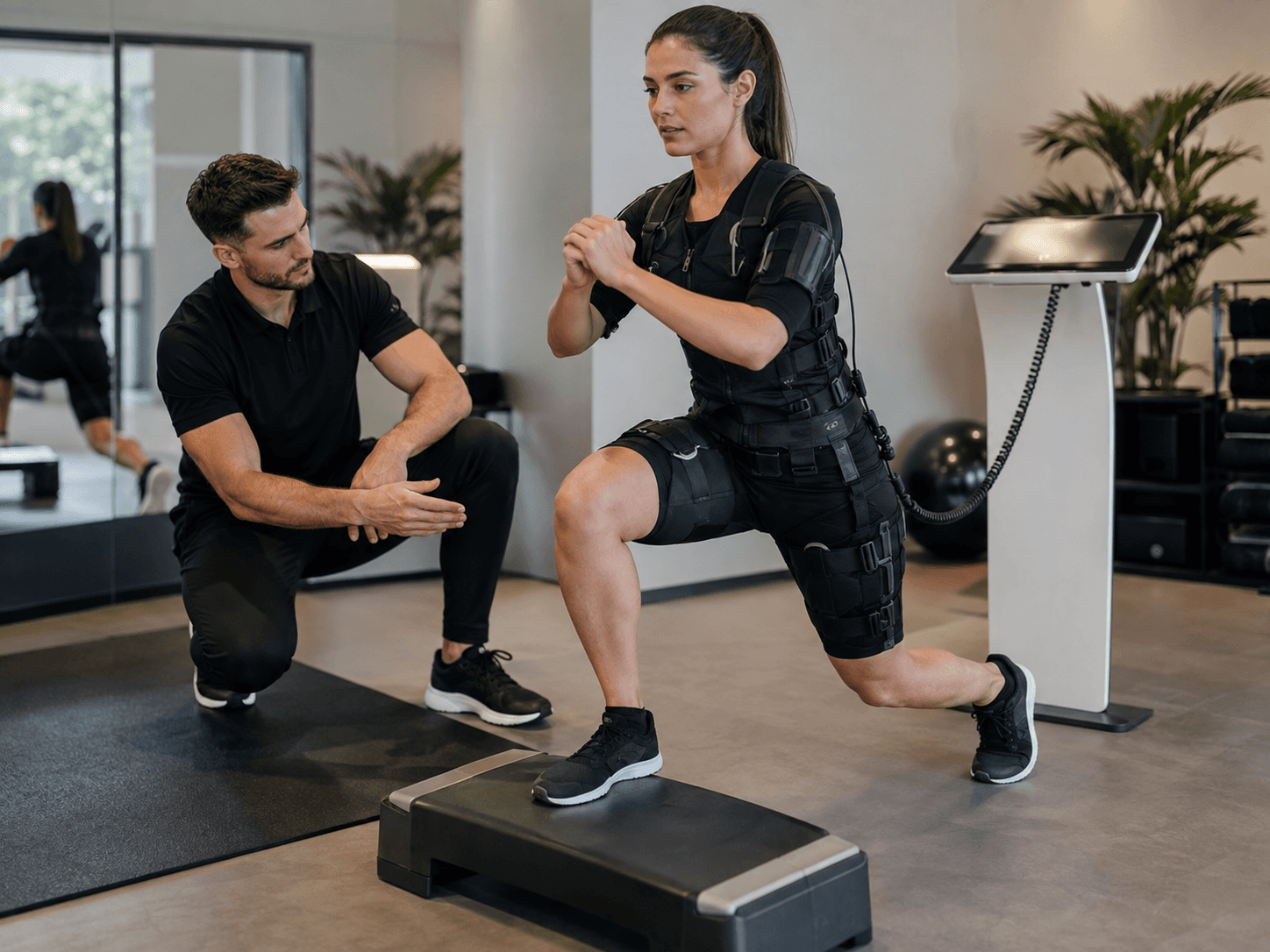
In a professionally delivered WB-EMS session, electrical stimulation is normally combined with voluntary exercises or guided movements. The participant is moving and contracting muscles while the system provides an additional electrical stimulus.
The 2023 international WB-EMS guideline describes the technology as simultaneous stimulation of major muscle groups with individually adjustable impulse intensity. It also emphasizes that professional application involves much more than operating the equipment.
A useful way to think about it is:
Suit + control system + electrical stimulation + movement + professional programming
Remove the last two pieces and you are no longer talking about the same professional experience.
What is the EMS suit actually doing?
Normally, your brain sends electrical signals through the nervous system telling your muscles to contract.
EMS introduces an external electrical stimulus that can also produce muscular contractions.
With WB-EMS, electrodes positioned around the body allow several muscle groups to receive that stimulus within the same training session.
That does not mean the technology somehow replaces the nervous system or makes exercise unnecessary. The electrical stimulus is being added to the work the participant is already performing.
This is one of the first distinctions professionals should understand because consumer marketing sometimes makes EMS sound almost passive:
- Put on the suit.
- Turn it on.
- Get fit.
Professional WB-EMS is more nuanced than that.
The equipment can provide a training stimulus, but the outcome still depends on factors such as programming, exercise selection, intensity, progression, frequency, participant characteristics, and recovery.
So why are professionals interested in it?
Because WB-EMS offers a training stimulus that is different from simply adding more external weight.
That can make it interesting to professionals looking for another way to structure strength-oriented training.
The value is not that WB-EMS magically makes conventional training obsolete.
It is that it gives the professional another tool.
For some businesses, that may mean offering a highly supervised training format. For others, the appeal may be the ability to stimulate multiple muscle groups during a relatively compact session. Some professionals may be interested in delivering muscular loading without relying entirely on increasingly heavy external resistance.
None of those points automatically means WB-EMS is the right choice for every client or every business.
But they explain why the technology deserves more serious consideration than simply dismissing it as an unusual-looking fitness suit.
Does Whole-Body EMS actually work?
This is where the conversation needs to move away from marketing claims and toward evidence.
There is legitimate research on WB-EMS.
A 2021 systematic review and meta-analysis examined 16 studies covering 897 non-athletic participants. The researchers found favorable effects on muscle mass and measures of leg and trunk strength. They did not, however, find a statistically significant effect on total body fat in that analysis.
That last point is worth paying attention to.
It would have been easy to take the positive muscle findings and turn them into:
“WB-EMS builds muscle and burns fat.”
But that would not accurately represent what that study found.
A broader systematic review and meta-analysis covering active and non-active adults also reported favorable findings across muscle mass, strength, power, and some body-composition measures, while noting limitations in the quality and consistency of the evidence.
So the sensible takeaway is not:
“WB-EMS works for everything.”
It is:
There is meaningful evidence supporting WB-EMS for certain muscle and strength-related outcomes, but results depend on the population, protocol, and outcome being measured.
For a professional deciding whether the technology belongs in a program, that distinction matters.
Is WB-EMS better than normal strength training?
That may be the wrong question.
If a trainer already has a well-designed resistance-training program, WB-EMS does not have to defeat that program in a head-to-head contest to have value.
A better question is:
Where could WB-EMS complement what we are already doing?
Traditional resistance training has enormous value. So do cardiovascular training, mobility work, sound nutrition, adequate sleep, and appropriate recovery.
WB-EMS does not make those things irrelevant.
Instead, it provides another way to generate muscular stimulation.
That may be useful in some professional settings and unnecessary in others.
A good professional should be able to make that distinction rather than trying to force every client into the same solution.
What makes professional WB-EMS different from simply buying an EMS suit?
This may be the most important point for U.S. professionals exploring the category.
Buying the equipment is relatively easy.
Building a responsible WB-EMS program around it is harder.
A professional service needs decisions around:
Who is appropriate for the program?
How are participants screened?
Who supervises the session?
How is stimulation introduced to a beginner?
How is intensity adjusted?
How does progression work?
How much recovery is appropriate?
What happens when a participant reports an unexpected response?
How are sessions documented?
The international WB-EMS guideline places considerable emphasis on qualified supervision, participant screening, careful familiarization, progression, communication, and recovery.
That is why professional WB-EMS education is about more than learning which buttons to press on a control unit.
What should U.S. professionals know about EMS regulation?
This is one area where U.S. professionals should be especially careful about copying claims or practices they see online.
Electrical muscle stimulators are regulated by the U.S. Food and Drug Administration as medical devices. Companies marketing these products in the United States must comply with the regulatory requirements that apply to their device and intended use.
That does not mean there is one blanket status called:
“WB-EMS is FDA approved.”
Different devices can have different regulatory status, labeling, intended uses, and marketing claims.
The FDA also makes an important distinction around exaggerated consumer claims. Its current information on electrical muscle stimulators says EMS devices have not simply been cleared for claims such as major weight loss, girth reduction, or producing “rock hard” abdominal muscles.
For a U.S. trainer, clinic, or wellness business, that means the equipment itself is only part of the due diligence.
You also need to understand what you are allowed to say about it.
What WB-EMS should not be sold as
WB-EMS does not need exaggerated promises to be interesting.
Professionals should be cautious when they encounter statements such as:
“20 minutes replaces 90 minutes in the gym.”
“EMS melts fat.”
“You don't need regular exercise anymore.”
“It works for everyone.”
“More intensity means better results.”
“Every EMS system is FDA approved.”
Statements like these either remove important context or go beyond what the evidence supports.
The FDA itself notes that repeatedly stimulating muscles electrically may contribute to strengthening or toning to some extent, but it does not support the idea that EMS alone creates dramatic changes in appearance without regular exercise and other factors.
A more credible professional conversation sounds different:
- Here is what WB-EMS can do.
- Here is what research has found.
- Here are the limits.
- Here is how we decide whether it fits the individual.
That may not make for the loudest advertisement.
It makes for a better professional standard.
Who should be paying attention to WB-EMS?
For SegaHealth, this question is more useful than saying everyone “needs” the technology.
Personal trainers
A trainer may want to understand WB-EMS as an additional training method, particularly if they are interested in expanding beyond conventional resistance-training formats.
But using the equipment professionally requires more than general personal-training experience. The trainer also needs to understand WB-EMS-specific programming, intensity, screening, and supervision.
Clinics and studios
For a clinic or studio, WB-EMS can represent an additional service line or training option.
The decision should go beyond buying suits and finding space for the equipment.
Staff training, participant flow, screening, documentation, supervision, program design, and equipment selection all become part of implementation.
Wellness professionals and operators
WB-EMS may also be relevant to wellness businesses looking at highly individualized, professionally supervised services.
Again, the technology needs to fit the business rather than the business being redesigned simply because the technology looks interesting.
Organizations
Larger organizations considering WB-EMS should think about implementation at a systems level: education, consistency, safety procedures, workforce readiness, equipment standards, and program oversight.
That is a different conversation from buying one suit for personal use.
Does every professional need WB-EMS?
No.
And there is no reason for SegaHealth to pretend otherwise.
A trainer with an established model and no clear use case may decide WB-EMS adds little to what they already offer.
A clinic may decide the operational requirements do not fit its current structure.
A wellness business may need more education before deciding whether the service makes sense.
Those are reasonable outcomes.
The purpose of professional education should be to help someone make a better decision, not to make the decision for them.
WB-EMS becomes more interesting when there is a clear answer to:
What does this allow us to do better or differently for the people we serve?
If there is no good answer yet, the next step may simply be learning more.
The suit is the visible part. The system is what matters.
WB-EMS tends to attract attention because the suit looks different.
But the suit is not the real story.
The real system includes the technology, the participant, the professional supervising it, the training plan, screening, progression, recovery, and the decisions made throughout the process.
Research gives professionals legitimate reasons to take WB-EMS seriously, particularly around muscle and strength-related outcomes in certain populations. But that does not turn it into a universal replacement for conventional training or a shortcut around good programming.
For U.S. professionals, there is another layer: understanding the equipment, its regulatory status and intended use, and how claims are communicated responsibly.
That is ultimately why WB-EMS is worth understanding.
Not because everybody needs it.
Because professionals should understand what it is, what it can realistically add, and where it belongs before deciding whether to use it.
Considering WB-EMS professionally?
If you are a trainer or wellness professional who wants to understand how WB-EMS is delivered professionally, explore SegaHealth's WB-EMS Certification & Training.
Internal link: /certifications
If you are evaluating WB-EMS for a clinic or studio, explore WB-EMS for Clinics & Studios for implementation guidance and professional support.
Internal link: /clinics & studios
For additional evidence and research resources, visit WB-EMS Science & Research.
Internal link: /science & research
Educational Notice
This article is provided for professional education and general informational purposes. It is not medical advice and does not determine whether WB-EMS is appropriate for a particular individual. Health history, medications, implanted devices, device instructions, applicable regulations, professional scope, and other individual circumstances should be considered before participation or implementation. Qualified medical guidance should be obtained when appropriate.
References
Rodrigues-Santana et al. (2023): Systematic review and meta-analysis covering 26 studies and 1,183 participants. It found positive effects on muscle mass, strength, power, and body-fat measures across active and non-active adults. This is much more relevant to the “why professionals are paying attention” angle.
Püttner et al. (2026), Strength & Power Meta-Analysis, very useful because it is recent and more nuanced. It found favorable overall effects on maximum strength and power in sportspeople, while additional benefits over voluntary exercise alone were smaller and not statistically significant in some subgroup analyses. That supports our message that WB-EMS may be useful without claiming it replaces traditional training.
Püttner et al. (2026), Jump, Sprint & Agility Meta-Analysis, this one is valuable precisely because the results were not strongly positive. It found no significant additional effects on maximum jump, sprint, or agility. Including research like this makes SegaHealth look much more credible because we aren't cherry-picking only favorable studies.
2025 WB-EMS Evidence Map for athletes/sportspeople, reviewed 34 research projects and shows the range of outcomes that have actually been studied, including strength, power, recovery, body composition, and safety. It also identifies evidence gaps. This is a strong source for explaining what science currently covers versus what still needs more research.
International WB-EMS Guideline (2023), keep this only where we explain what professional WB-EMS actually is and why supervision/programming are part of the system. It defines WB-EMS as simultaneous stimulation of major muscle groups with individualized intensity and emphasizes qualified supervision.
FDA , Electronic Muscle Stimulators, keep this only in the short U.S. regulatory section. We need it because the article specifically targets the United States, but it shouldn't be one of the main scientific references about performance.
Latest News & Blogs